Saturday, 9 October 2010

Diorama as pastiche


Is is the colours, the lighting of the backdrop, the hazy dreamy look about it, the colours of yesteryear, or just that it has acquired an aura about it with age? Is is an older type of landscape painting, looking towards a different ideal? A wholehearted belief in something wonderful, more optimistic somehow. Perhaps a more wholehearted belief in man's dominion over the animals and the natural world. Wanting to depict animals in an idyllic setting even if they were about to be pounced upon by another. Perhaps it is that a lot of the dioramas are quite old now, and the work done by previous esteemed diorama artists is periodically subject to conservation and renovation.

However, it could be looked upon as shop window dressing in a way. Preserving little scenes or tableaux.

Hannah Tinti/Animal Crackers - Preservation


This is the book by Hannah Tinti, Animal Crackers - using the story "Preservation" as a backdrop for my studies in museum culture. Most of the stories display the loneliness of the human as distinct from the animal kingdom, removed from their animal qualities in their status of humans in dominion and also as distinct from the animal kingdom. She has a gift for painting a surreal juxtaposition in words.

Motif of the brown bear


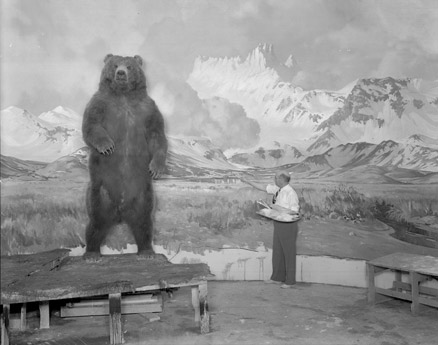
Looking at brown bears, for Hannah Tinti's "Preservation" story, this is a good strong image, taken from the American Natural History Museum.

Rodin's Burghers of Calais


Gunther von Hagen and plastination as preservation


Research into the issues with the short story "Preservation" by Hannah Tinti, one of which is the difficult issue that might arise if a family member wants to have his/her body donated to science, as in the case of Gunther von Hagen of "Body Worlds", but in this case it is also to be in a scenario from a well known work of art, "The Burghers of Calais" a sculpture by Rodin. It's a double-bind as the story also deals with life size sets of dioramas, also preserving a scene, a moment in history, where animals are removed from their natural environment, and preserved and displayed in narrative scenes. There are a lot of human and animal ethical questions raised in the issues in the story.

Empty spaces in the museum

Treating with arsenic and other poisons.


The exhibits at Manchester Museum, removed from glass cabinets and kindly shown to me by one of the curators, have been treated with arsenic, amongst other things to preserve them and will be wrapped and frozen to prevent any further decay.